Contribution of Physiotherapy to Development in Children with Down Syndrome: Motor Development, Hypotonia, and Rehabilitation Guide
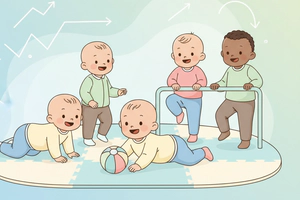
Down syndrome (Trisomy 21) is a genetic difference that makes every child’s developmental journey unique. In this journey, one of the most frequently asked questions by families is, “How is Down syndrome supported with physiotherapy?” This is because motor development milestones (head control, rolling, sitting, crawling, standing up, walking) may progress more slowly in babies and children with Down syndrome due to reasons like hypotonia (muscle laxity), joint laxity, and balance and coordination difficulties. This situation does not mean “falling behind”; with correctly planned Down syndrome physical therapy and rehabilitation approaches, children can get stronger according to their potential, move more independently, and increase their participation in daily life.
In this article, you will find why the Down syndrome motor development process might progress differently, the contributions of physiotherapy to development, assessment and goal setting in the trisomy 21 rehabilitation plan, an age-based roadmap, and safe game-based suggestions that can be applied at home. Our aim is to offer clear, applicable, and family-friendly answers to the questions “what is done, what is expected, and how to support at home?”.
Why Can Motor Development Progress Differently in Down Syndrome?
There are a few basic factors that can affect motor development in children with Down syndrome. Knowing these not only reduces family anxiety but also makes physiotherapy goals clearer.
Hypotonia (Muscle Laxity) and Postural Control
Down syndrome hypotonia is frequently seen together. Hypotonia is the difficulty a baby has in maintaining posture against gravity due to muscles being “loose” (lax). This situation may create a need for more support, especially in areas such as:
- head and trunk control,
- endurance in the prone (tummy) position,
- maintaining sitting balance,
- stabilizing the trunk while standing up.
The important point here is this: The goal of “increasing muscle tone” is often misunderstood. In physiotherapy, the aim is not solely to “increase tone”; it is to improve trunk stability, strength, endurance, and functional movement quality.
Joint Laxity and Balance-Coordination
Due to connective tissue laxity (joint hypermobility), the need for stability around the ankle, knee, and hip may increase in some children. This affects balance and can lead to symptoms such as:
- walking with a wider base,
- frequent falling,
- difficulty in transitions on stairs and different floor surfaces.
Endurance and Motor Planning
In children with Down syndrome, muscle endurance and motor planning skills (organizing and sequencing movement) may occasionally require more practice. Therefore, a Down syndrome rehabilitation program becomes more effective when planned with short and frequent repetitions, a game-based structure, and a format that maintains the child’s motivation.
What Does Down Syndrome Physiotherapy (Physical Therapy) Provide?
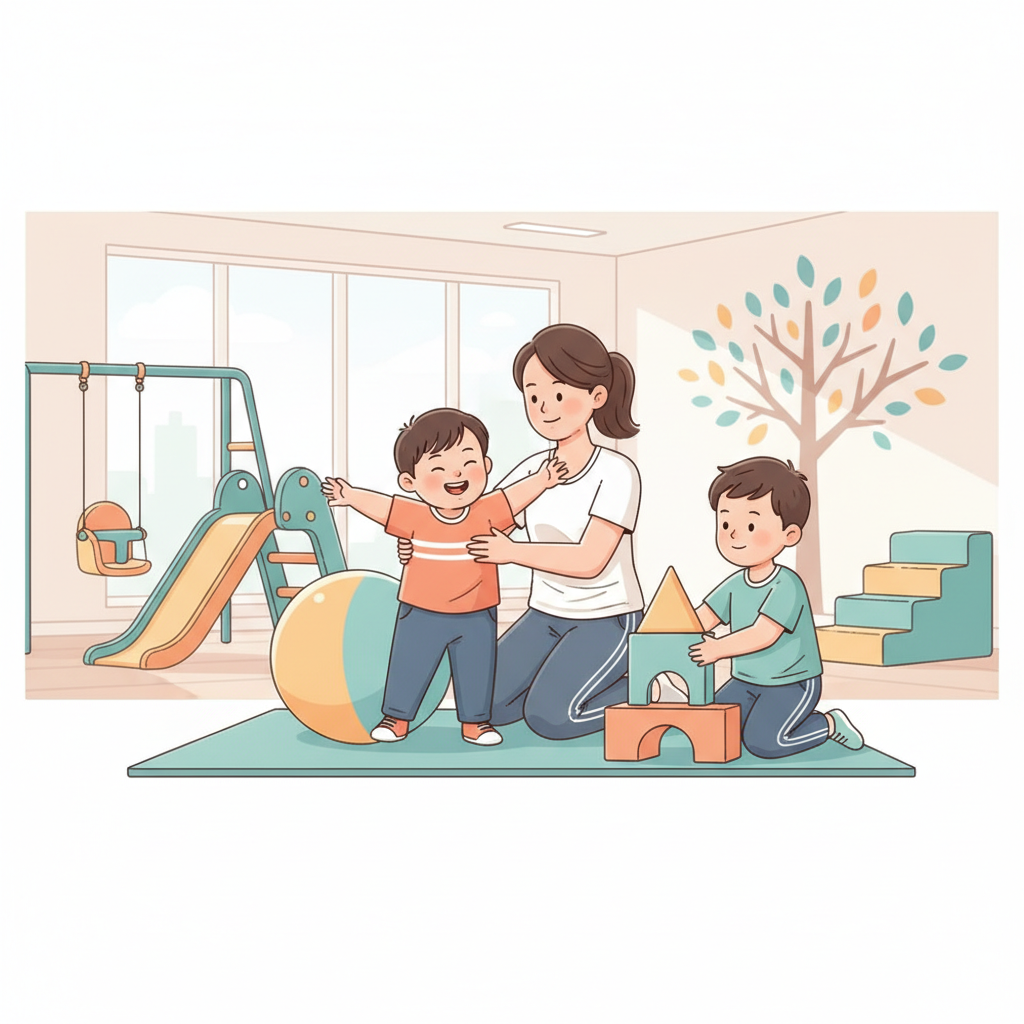
At the center of Down syndrome physiotherapy practices is “function”: The goal is for the child to move more comfortably in daily life, participate in games, and be more independent in school and social life. Below are the areas where physiotherapy most frequently contributes.
1) Supporting Motor Milestones
The physiotherapist works according to the child’s needs on steps such as head control, rolling, sitting, crawling, standing up, and walking. For example:
- Activation of shoulder girdle and back muscles with prone games,
- Trunk rotation with side-lying and rolling,
- Balance reactions with supported sitting,
- Preparation for crawling and standing up with weight shifting.
2) Balance, Coordination, and Walking Quality
Physiotherapy is very valuable even after walking begins in children with Down syndrome. Because the target is not just “walking”; it is walking more safely, more balanced, and expending less energy. In sessions:
- balance games,
- single-leg weight bearing preparations,
- step/stair work,
- changing direction and stop-start practices
can be used.
3) Posture and Orthopedic Follow-up
When trunk stability is weak, children may develop some compensatory postures (shoulders slumping forward, excessive arching of the lower back, etc.). Physiotherapy contributes to moving more comfortably in the long term by supporting posture. When deemed necessary, orthosis and assistive device options may also be considered (decisions are always made specifically for the child).
4) Family Education and Home Program
One of the elements that creates the biggest difference is carrying the sessions into home life. The physiotherapist plans home activities suitable for the child’s level, suggests correct carrying/positioning, and teaches the family “how to sprinkle these into the day.” This approach makes the Down syndrome physical therapy process sustainable.
Related reading: For more detailed information about hypotonia, the following article may be useful: Hypotonia (Floppy Baby Syndrome) and Physical Therapy Approaches
Assessment and Goal Setting in Trisomy 21 Rehabilitation
An effective trisomy 21 rehabilitation plan begins with a good assessment. Instead of a “same exercise for everyone” approach, a roadmap is drawn that identifies the child’s strengths and areas of difficulty.
What is Looked at in the First Assessment?
The physiotherapist generally observes and measures the following areas:
- Muscle tone, trunk stability, and strength
- Joint range of motion and joint laxity
- Balance reactions and coordination
- Motor milestones (sitting, crawling, standing up, walking)
- Walking pattern (if present), frequency of falls, fatigue
- Participation in daily life: play, park, school activities
If necessary, the plan is enriched with evaluations from other specialists through a team approach. Especially during the special education and rehabilitation process, having mutually compatible goals helps the child progress faster.
Measurable Goal Examples (Concrete and Trackable)
Concrete goals increase motivation instead of vague goals (“get better”). Examples:
- “Staying balanced for 30 seconds in supported sitting within 4 weeks”
- “Transitioning from two-hand support to one-hand support when standing up from the floor within 6 weeks”
- “Walking with 10 fewer falls within 8 weeks”
- “Climbing/descending 4 steps on stairs while holding on”
What Should the Family Expect in Sessions?
Many families ask, “How does a Down syndrome physiotherapy session go?” A general example flow might be:
- Warm-up and gathering attention with play
- Trunk stability and balance games
- Functional transitions (lying down to sitting, sitting to standing)
- Goal-oriented work such as walking/stairs/obstacle courses
- Home program and daily routine suggestions
Session frequency varies according to the child’s needs; it may be planned as more intensive in some periods or as follow-up sessions in others.
If you would like to follow motor development milestones more closely: 0-12 Month Baby Motor Development Milestones and Supportive Games
Physiotherapy Goals by Age and Home Support: Practical Roadmap
The suggestions below offer a general framework; the most accurate plan is determined according to the child’s assessment.
0–6 Months: Head Control and Symmetry
Goals
- Supporting head control
- Increasing prone tolerance
- Improving right-left symmetry
Home game ideas
- Short-duration prone play (tummy time) (several times a day, frequent but short)
- Right-left tracking exercises with toys
- Giving opportunities for head control by supporting the trunk while carrying in arms
6–12 Months: Rolling, Sitting Balance, Weight Shifting
Goals
- Control in rolling and side-lying
- Supported/independent sitting
- Weight bearing on hands (preparation for crawling)
Home game ideas
- Reaching to both sides to grab toys while sitting (balance reactions)
- Weight shifting games on a low cushion
- Pushing games similar to “mini push-ups” with support on hands (gamified)
1–3 Years: Crawling, Standing Up, Walking, and Balance
Goals
- Functional transitions (getting up from the floor, squatting)
- Walking quality and reducing falls
- Balance and coordination (stop-start, changing direction)
Home game ideas
- Ball pushing/pulling games (trunk control + balance)
- “Obstacle crossing” course on pillows/carpet
- Climbing up and down a low stool (with safe supervision)
Preschool and School Age: Endurance, Stairs, Running, and Play Participation
Goals
- Increasing endurance (reducing quick fatigue)
- Running, jumping, single-leg preparation
- Participation in play and sports activities
Home game ideas
- Stop-start game with music
- Hopscotch preparation (first two-footed jump, then stepping on lines)
- Safe climbing and slide activities at the park (with supervision)
For more tips on balance and coordination: How to Understand Balance and Coordination Problems in Children?
“Increasing Muscle Tone” and the Correct Approach in Hypotonia (Misconceptions)
Although increasing muscle tone is one of the phrases families frequently search for, the sole goal in hypotonia is not to “raise tone”. Tone is the basic tension level of the nervous system on the muscle; it should not always be thought of as something that can be directly “increased by exercise”. More realistic and functional goals in physiotherapy are:
- Trunk stability: The child can “hold” their trunk better while sitting or walking.
- Strength and endurance: Can play for longer periods, gets tired less.
- Movement quality: Stands up and sits down with more control, takes safer steps.
- Function: Independent movement and participation increase.
Approaches to Avoid
- Excessive stretching and uncontrolled flexibility exercises (careful with children who have joint laxity)
- Forcing the child into positions they are not ready for (e.g., making them sit unsupported for a long time)
- Repetitions that tire the child and lower motivation with the idea “the more the better”
The best results are usually obtained with short-duration, frequently repeated, gamified activities spread throughout the daily routine.
Frequently Asked Questions (FAQ)
When should physiotherapy for Down syndrome start?
An early intervention approach is generally recommended. Supporting correct positioning, trunk control, and symmetry during infancy can positively affect motor development in the long run. Evaluation by a pediatrician and physiotherapist is important for the most accurate timing.
How many sessions of physical therapy are needed for Down syndrome?
There is no single number; it is planned according to the child’s needs, goals, the applicability of the home program, and accompanying conditions. Weekly follow-ups may be appropriate in some periods, while less frequent control sessions may be suitable in others.
Is delayed walking normal?
Walking may start later in children with Down syndrome. What matters is that the child progresses through the milestones safely and that walking quality is supported. Professional evaluation is required in situations causing anxiety.
Are special education and rehabilitation carried out together with physiotherapy?
Yes. For most children, the most effective approach is multidisciplinary work. While physiotherapy supports motor skills, special education can strengthen cognitive/learning areas, and other therapies can strengthen communication and daily living skills.
Conclusion: Physiotherapy is Support that Unlocks Potential
Down syndrome physiotherapy and Down syndrome physical therapy approaches support the child’s development in many areas, from head control to walking, from balance to endurance. The strongest effect emerges with correct assessment, measurable goals, family education, and game-based activities integrated into the home routine. Remember: Every child’s speed and needs are different; the important thing is not to compare, but to regularly track the child’s own progress.