Play-Based Physiotherapy: How Combining Play Therapy with Physiotherapy Accelerates Recovery in Children
Children explore the world through play; they often learn to move, balance, fall and get back up, and develop new skills not by saying “I am exercising,” but while playing games. Therefore, play-based physiotherapy—adapting physiotherapy goals into a gamified format that fits the child’s world—is a highly effective approach in the pediatric physiotherapy process that strengthens both motivation and results. However, there is an important distinction here: In Turkey, when “play therapy” is mentioned, it is often understood as psychological play therapy. In this article, our focus is on how pediatric physiotherapy and the play in pediatric rehabilitation approach support a child’s motor development and functional skills.
So, does “fun physical therapy” done through play really work? Yes—because the child repeats movements they find difficult more often within a game, fear and avoidance decrease, and the sense of success increases. Moreover, when planned correctly, play can target goals such as balance, coordination, strength, posture, and endurance simultaneously. In this article, we will cover step-by-step what play-based physiotherapy is, which children it is suitable for, how sessions are planned, what can be done for increasing motivation in therapy, and safe therapy games for children that can be applied at home.
Play Therapy or Play-Based Physiotherapy? Let’s Clarify the Confusion
Since the term “play therapy” can be used in two different fields, parents may get confused:
What is psychological play therapy?
Psychological play therapy is applied by psychologists with goals such as helping the child express emotions, cope with trauma/anxiety, and regulate behavioral problems. Toys and symbolic games are tools to understand and support the child’s inner world.
What is play-based physiotherapy?
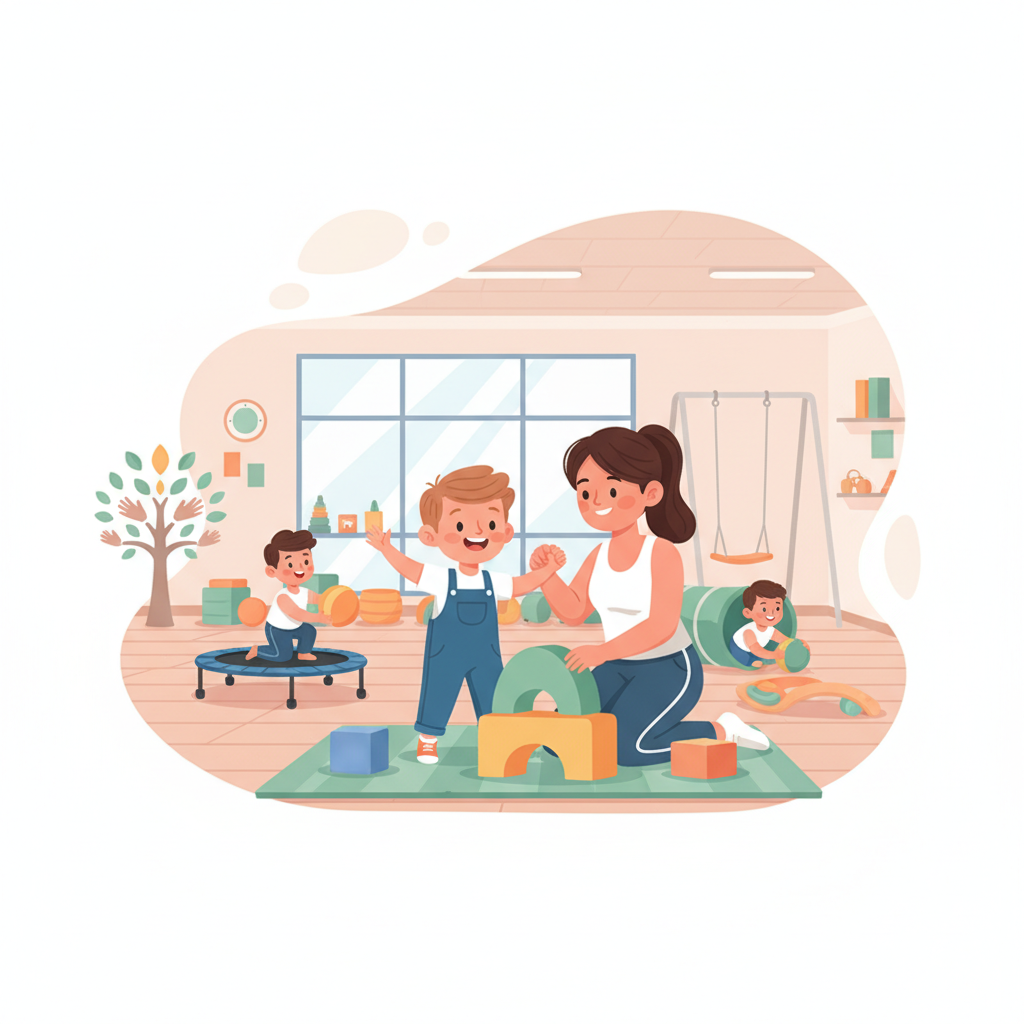
Play-based physiotherapy is when a physiotherapist converts goals such as balance, coordination, muscle strength, joint range of motion, posture, gait training, and functional skills into a physiotherapy with play format. Here, play is not the “goal,” but the “tool.” For example:
- Balance goal → “crossing the bridge” game on a line on the floor
- Strength goal → “bear walk” for core and shoulder girdle work
- Coordination goal → catch-and-throw ball, hitting targets, jumping to rhythm
This approach is particularly beneficial for families who say “my child doesn’t want to go to physiotherapy,” as it increases the child’s participation in the session. Additionally, play allows for more efficient use of the child’s attention span; repetition counts rise with short, fun, and goal-oriented blocks. As the number of repetitions increases, the brain’s motor learning capacity is supported; meaning the child carries the “movement they learned” better into daily life.
What Does Play in Pediatric Rehabilitation Improve in Children?
Play in pediatric rehabilitation is not just about “keeping the child occupied”; correctly chosen games serve the most critical goals of therapy. Here are the areas where the play-based approach frequently works:
1) Balance and coordination
Balance plays a fundamental role in children’s daily skills such as climbing stairs, standing on one foot, running, and sudden changes of direction. Working on balance within a game is very natural: activities like hopscotch, walking on a line, and the “statue game” (freezing when the music stops) develop both static and dynamic balance. This increases session compliance, especially in children experiencing balance and coordination problems. (Another relevant read: How to Detect Balance and Coordination Problems in Children?)
2) Gross motor skills and motor planning
Skills such as jumping, hopping, squatting, running, and overcoming obstacles fall into the “gross motor” category. Games like obstacle courses, reaching for a target, and changing direction with color/shape commands strengthen motor planning (planning what to do). This can reduce difficulties that appear as “clumsiness” in the child.
3) Posture and core stability
Trunk control is considered the foundation for both walking and fine motor skills. Activities within games such as “picking up toys from the floor,” “passing through a tunnel,” “carrying a balloon,” and “sitting on a balance cushion to hit a target” work the core muscles. In this way, the child can sit more upright and get less tired during desk activities.
4) Endurance and movement confidence
Some children get tired quickly or avoid movement because they are afraid of falling. Play gives the child the feeling of “I can do it.” Endurance increases with gradual difficulty; as the child moves, their self-confidence rises. This strengthens session continuity in the long run.
5) Regulation of sensory needs (in appropriate cases)
Some children seek movement excessively (desire to jump/spin), while others avoid it. The physiotherapist can support regulation by adjusting the intensity of the game according to the child’s needs. In cases where sensory processes are handled in more detail, cooperation with occupational therapy is important. (See: Symptoms and Treatment Methods of Sensory Integration Disorder)
Which Children Is It Suitable For? (Diagnosis-Independent, Goal-Oriented Approach)
Rehabilitation with play can be adapted to many different needs. The main idea here is: Regardless of the diagnosis, the physiotherapist assesses and arranges the game according to the child’s goals. Example situations:
- Developmental delay or delay in motor milestones: Goals like crawling, standing up, and independent walking can be supported with play.
- Cerebral Palsy (CP): Postural control, balance, gait patterns, and functional movements can be gamified to increase repetition numbers. (Detail: The Role of Physiotherapy in Cerebral Palsy (CP) Rehabilitation)
- Torticollis (wry neck in babies): Games supporting positioning and active head control (visual tracking, guiding with sound toys) can be used. (Detail: Torticollis in Babies and Physiotherapy Solutions)
- Orthopedic problems, postural difficulties, scoliosis accompaniments: Posture awareness and symmetrical load transfer can be worked on within a game.
- Motor skill difficulties in the Autism spectrum: Session compliance may increase with structured play, visual support, and routine.
Important note: The play-based approach does not mean “the same game for every child.” Random games played without determining the child’s age, attention span, sensory profile, musculoskeletal needs, and goals can be inefficient. Therefore, a pediatric physiotherapy assessment must be at the center of the plan.
How is a session plan established? (Assessment → goal → game selection)
- Assessment: Balance, strength, joint movement, gait, posture, coordination, and functional skills are observed/measured.
- Goal setting: Measurable goals are selected, such as “reducing fear when climbing stairs,” “standing on one foot for 5 seconds,” or “catching a ball with two hands.”
- Game selection and grading: The game progresses from easy to hard (progression). For example, first walking on a wide line, then a narrow line, then adding obstacles.
- Progress tracking: Progress is made visible with data such as duration, number of repetitions, balance time, and step count.
Increasing Motivation in Therapy and Safe Games Applicable at Home
One of the most frequently heard sentences in child physiotherapy is: “My child doesn’t want to go to the session.” At this point, there are practical methods to use both in the clinic and at home for increasing motivation in therapy.
6 strategies that increase motivation in the clinic
- Give a choice: Offering two options like “Tunnel first or target hitting?” increases the sense of control.
- Set micro-goals: Instead of 20 minutes “in one piece,” 5-minute game blocks are planned.
- Visual chart/sticker system: Concretization like “complete 3 stations, earn 1 star” works.
- Make success measurable: “8 steps on the line today, 10 steps next week.”
- Adjust the difficulty level correctly: A game that is too hard increases avoidance; a game that is too easy creates boredom.
- Routine + surprise balance: If part of the session is familiar and part is new, trust and curiosity progress together.
5 short “child physiotherapy games” applicable at home (10–15 minutes)
These games can be a practical start for families looking for home physiotherapy exercises child. However, if the child has a specific condition, adapt according to the physiotherapist’s suggestion.
- Bridge Game on the Line (balance)
- Make a line on the floor with tape.
- The child walks on the line as if “crossing a river.”
- Progression: Carrying a light toy in hand, walking backward.
- Animal Walks (strength + core)
- Bear walk, frog jump, crab walk.
- Gamify it like 3 laps = 1 point.
- Caution: Stop if there is wrist/shoulder pain.
- Target Hitting with Balloon (coordination + posture)
- Guiding the balloon to a set target without letting it drop to the floor.
- Variations like two hands, one hand, touching with the knee can be added.
- Home Obstacle Course (gross motor + motor planning)
- Jumping over pillows, walking around chairs, crawling through a tunnel.
- Add a command game: “Step on red, touch blue.”
- Statue Game (balance + reaction)
- Music plays, everyone freezes when it stops.
- One-legged statue, squatting statue variations are arranged according to the goal.
Safety: When to stop, when to consult an expert?
- Stop the game if there is pain, significant limping, dizziness, shortness of breath, or excessive fatigue.
- If the child constantly avoids, cries, or is afraid of movement; the goal and difficulty level should be re-evaluated.
- In diagnosed children (e.g., CP, torticollis, etc.), the home program must be personalized with expert guidance.
Local search intent: Note for families searching for “child therapy / child physiotherapy”
If you have searched for terms like child therapy or child physiotherapy, the first meeting usually involves assessment, goal setting, and home program planning. A good pediatric physiotherapy process involves the family, supports progress with small games applicable at home, and makes “recovery” visible with regular measurements. When choosing a center, it is beneficial to ask about criteria such as the physiotherapist’s pediatric experience, communication approach, and home program follow-up. (Additional guide: How to Choose the Right Pediatric Physiotherapist?)